
Utah County Busted Booking Records
Booking at the Utah County Jail begins when an agency brings a person to the County Security Center in Spanish Fork. The Sheriff's Corrections Division runs the whole system. A booking record is narrower than many people assume. It marks a single jail event, tying an arrest date to a booking date, the arresting agency, and a custody status. It is not an arrest report. It is not a charging document. Nothing in it comes from a court. Municipal police arrests show up only when they end in a county-jail booking, so plenty of police contacts never appear.
The Booking Bureau never closes. It estimates more than 28,000 booking and release events a year, holds roughly 800 prisoners, and works over 200 cases a day. Those figures come from the Sheriff's Booking Bureau. They measure sheer workload, not individual people or finished cases.
Utah County Booking Detail Fields
Pick a person in the official search and the Sheriff's booking detail opens up. It lists the arrest date, the booking date, a booking number, and a release date if one applies. You also get the arresting agency and a status indicator. Each field does its own job. The booking number marks one jail event, while a release date says nothing about how the case turned out. Charge, release-type, and court-code context appear in the interface too, but none of it replaces what a court file would tell you.
| Field | What it tells you |
|---|---|
| Arrest date | The date tied to the reported arrest event, which can differ from intake. |
| Booking date and number | The County Security Center intake event and its identifying number. |
| Release date | A release date when the record supplies one, not a case outcome. |
| Arresting agency | The agency associated with the booking, not necessarily the later court custodian. |
| Status and court clues | Custody processing information and a possible route to later court research. |
Status codes read simply. Code A means active in custody. Code O means released. The other published codes cover special situations: C for commitment on file but not in custody, D for work diversion, E for GPS monitoring, and L for 24/7 alcohol monitoring. Rounding out the list are R for medical refusal, Y for held at another facility, and Z for walked away. Every code describes a jail-system state at a moment in time.
Utah County Record Requests
When the web index can't settle a specific record question, Utah County Sheriff Records is the local GRAMA route. The current Records page points requests to an online portal. Photo ID is required before anything is released. Asking for another person's record? A notarized release is required. Reports start at $15, with extra costs possible. An older linked PDF still quotes $5 plus digital-media fees, so treat the current page as authoritative and ask Records for an estimate.
The Sheriff Records page sends requesters to the current Utah County NextRequest portal to file a focused written request.
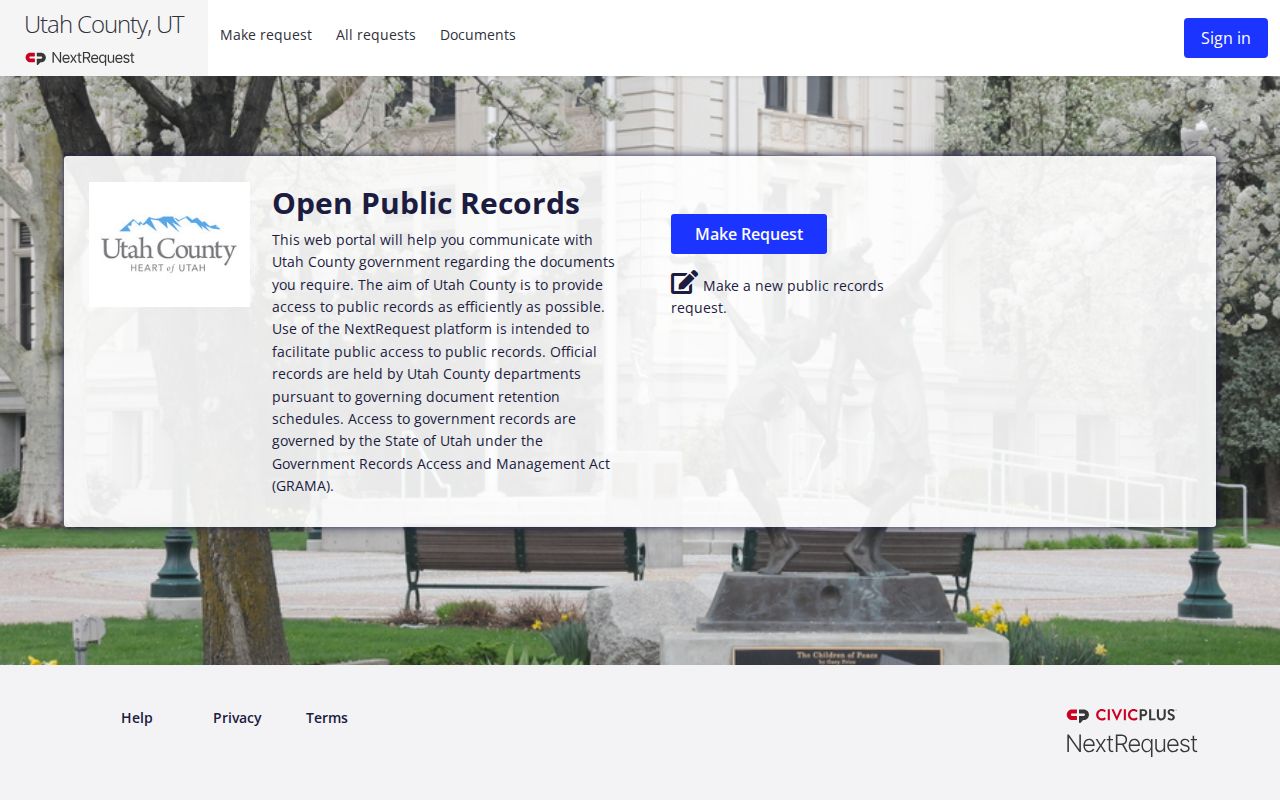
One caveat on the portal: it helps identify an existing County record for the custodian. It guarantees nothing about whether a requested item is actually held, public, or releasable.
- Name Utah County Sheriff Records as the custodian and identify the person accurately.
- Include a booking, case, or incident number if known, plus a narrow date range.
- State the specific existing record sought and ask for a cost estimate before extra charges.
- Provide identification and any required authorization, then await the written response.
Records sits at County Security Center, 3075 North Main, Spanish Fork, UT 84660. The direct line is 801-851-4500. Hours run Monday through Thursday, 8 a.m. to 5 p.m., with Friday hours of 8 a.m. to noon. Under GRAMA, a response should come as soon as reasonably possible and no later than 10 business days. That response may grant the request, deny it, report no record, or invoke lawful extraordinary circumstances.
Note: No source offers a fixed price or automatic release promise for a protected jail-booking image.
Utah County Busted Mugshot Law
Utah law treats an arrest record and a jail-booking image as two different things. Under current Utah Code § 63G-2-305(80), a booking image is protected unless a stated exception applies. The Sheriff's search still carries older language about its site. It says a booking picture and its information stay up for 30 days, after which the photo drops off and the text remains for one year. That description covers the interface only. It is not a promise that any photo is currently visible or available on request.
Utah Code § 17-72-802 restricts how a sheriff may hand out booking-photo copies, especially where an image is protected or bound for a publish-for-pay site, and it builds in limited removal rules for qualifying publishers. Nothing there forces news outlets, social posts, or other independent publications to take anything down. A correction request to Utah County should name the exact record and the claimed factual error. County Code § 2-3-9 lays out a written correction path that keeps both the original and the corrected record.
The courtroom route works differently. Utah Courts expungement information makes clear that eligibility is fact-specific and that expungement seals government records, not news stories. For forms and official navigation, start with the state's BCI expungement resources.
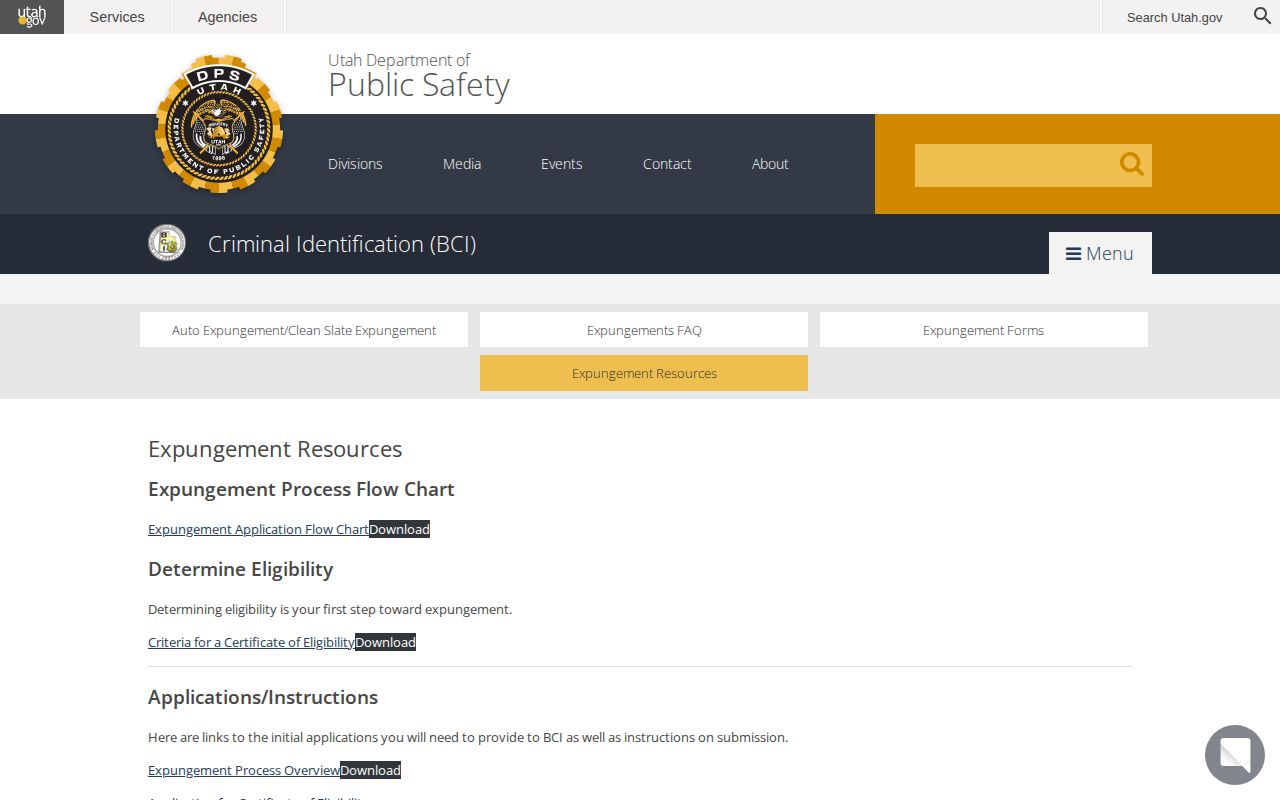
Those official sources point you to the right legal process. They promise nothing more. None of them forces another publisher to change its material.
For content on a verified publisher's page, use that publisher's own no-fee route. RecentlyBooked's published policy lays out documented correction and removal paths, and Mugshots.com runs its own record-maintenance route for documented updates. Neither policy touches a Sheriff or court record. Skip any third party charging money for a bare removal promise. Stick with the court, agency, statutory, publisher, and search-engine routes that actually apply to your case.
Utah County Record Corrections
Fixing an error and wiping out a record are two different things. Under Utah County Code § 2-3-9, you send a written request to the agency holding the record. Say what should change and why. The County usually keeps the original plus the corrected version. If it says no, an appeal process follows. This path covers factual errors in a specific Sheriff record. It will not pull a booking photo off the site. Nor will it erase a valid record just because someone dislikes it.
Utah County Busted Timing
Timing in Utah County comes down to one local rule. The Sheriff says booking information shows up 24 hours after the booking itself. That beats any generic promise of live updates. So an early tip, a police report, or a news item can surface before the official record does. A day-of search is not a real-time roster. A blank first-day result does not mean no booking happened.
Wait out the window before trying again. If the answer still has not appeared after that period, a precise record request is the right fallback. The gap can also point to a release, a transfer, a citation, a medical refusal, a misspelled name, or a different custody system.
Timing answer: Utah County publishes booking information after 24 hours, not as a same-day rolling arrest feed.
Busted Utah County Web Lifecycle
The Sheriff's own wording sketches a timeline, but only for the website. Booking information and a picture stay up for 30 days. Remaining booking text lasts one year. A name search, the same source says, reaches inmates from the past two years, present ones included. Read those as facts about the site's display. They add up to neither a complete two-year archive, a permanent photo collection, nor a records-destruction date.
Utah County Roster Search
Utah County's Arrested Person Search is the main tool for current and recent bookings at the County Security Center. Enter a name plus an arrested date. A separate Current Inmates option sits alongside it. The name guidance asks for as much of the name as you can give, in a style like "ADAMS, B." Per the Sheriff, a name search covers inmates from the past two years. Other help text describes shorter on-site display windows for details. Treat both as interface notes rather than a promise of a permanent archive.
The official roster-search interface shows the name and arrested-date fields, plus the Sheriff's published 24-hour availability notice.
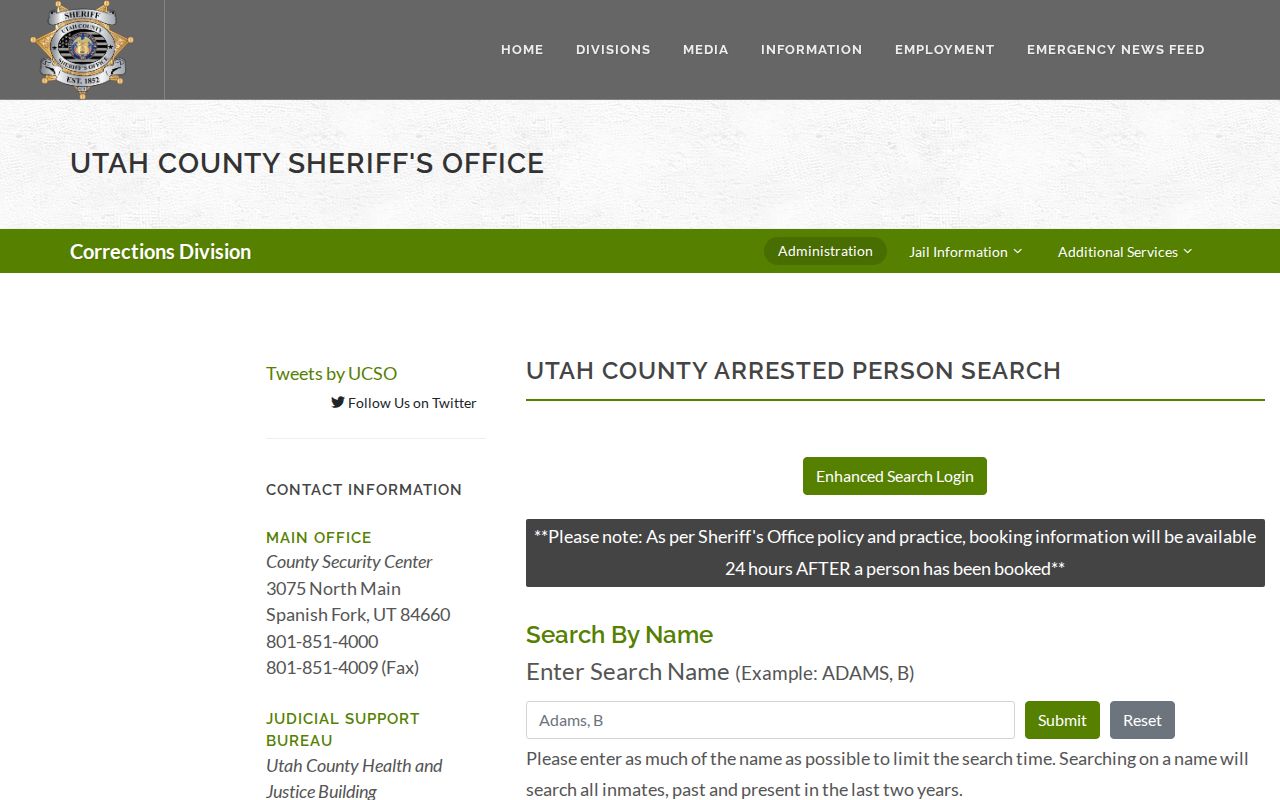
Open the booking detail through the official interface and read the status key there. A name match alone does not prove current physical custody.
| Search option | Format or use | Limit |
|---|---|---|
| Name | Surname plus as much given-name information as known | Historical substitute, not a court-name search |
| Arrested Date | MM-DD-YYYY | Available only after the stated 24-hour delay |
| Current Inmates | Current Sheriff-tracked custody view | Not a recent-arrests log |
- Try the surname with known first-name detail.
- For a date-bounded question, enter the arrested date in the required format after the delay.
- Open the matching booking detail and compare arrest date, booking number, agency, and status.
- Use a court clue only as a bridge to the court system, then request a specific record if the web display is not enough.
Busted Utah County Date Search
Utah County offers no separately branded last-24-hours, 48-hour, 72-hour, weekly, or monthly bookings feed. The functional chronological tool is the arrested-date field. After the Sheriff's availability window, it works as a date-searchable booking index. It is not a rolling arrest log or a current-day feed, and the official route is built around a single MM-DD-YYYY date. Calling it an open-ended calendar archive would misstate it.
For a multi-day question about one person, name search is the documented substitute. A name can return several booking events. Pick the right one by its date and booking number. Then read the release date and the status as separate fields. The Sheriff Press Archive can add official context for a known incident, but it is no stand-in for a full roster or booking-photo feed.
Note: Utah County bookings have no fixed cutoff time, rolling-feed window, or web-photo archive published by the Sheriff.
Utah County Custody Channels
Match each custody question to the right source. County and state officials come first. They name the agency record and its limits. A county booking, a state-corrections record, federal custody, immigration custody, and a court case each mark a different stage. That is also why a result never guarantees a booking image.
| Channel | Custody or record scope | Photo position |
|---|---|---|
| Sheriff Arrested Person Search | Utah County booking history and current-inmate context | Legacy display language exists, but current law protects jail-booking images absent an exception. |
| Sheriff Records and GRAMA | Focused existing Sheriff records | Classification controls release or copying. |
| UDC Offender Search | State prison custody or UDC probation and parole supervision | UDC addresses prison photos through its own public-information process. |
| Xchange | Public district and justice court case history | Not an image service. |
| BOP and ICE locators | Separate federal or immigration custody systems | Neither is a Utah County booking-photo source. |
Need to find someone held at the state level? The UDC Offender Search covers people in Utah Department of Corrections custody, plus those on parole or probation supervision. Enter a name or a UDC ID. The result shows an official label: inmate, parolee, or probationer. That is its limit. It will not confirm a fresh Utah County arrest. The BOP Inmate Locator and the ICE Online Detainee Locator fill separate federal and immigration roles, and neither is documented to return booking photos for this county. For state custody, use the Utah Department of Corrections offender search; just remember it is a state tool, not a County Security Center roster.
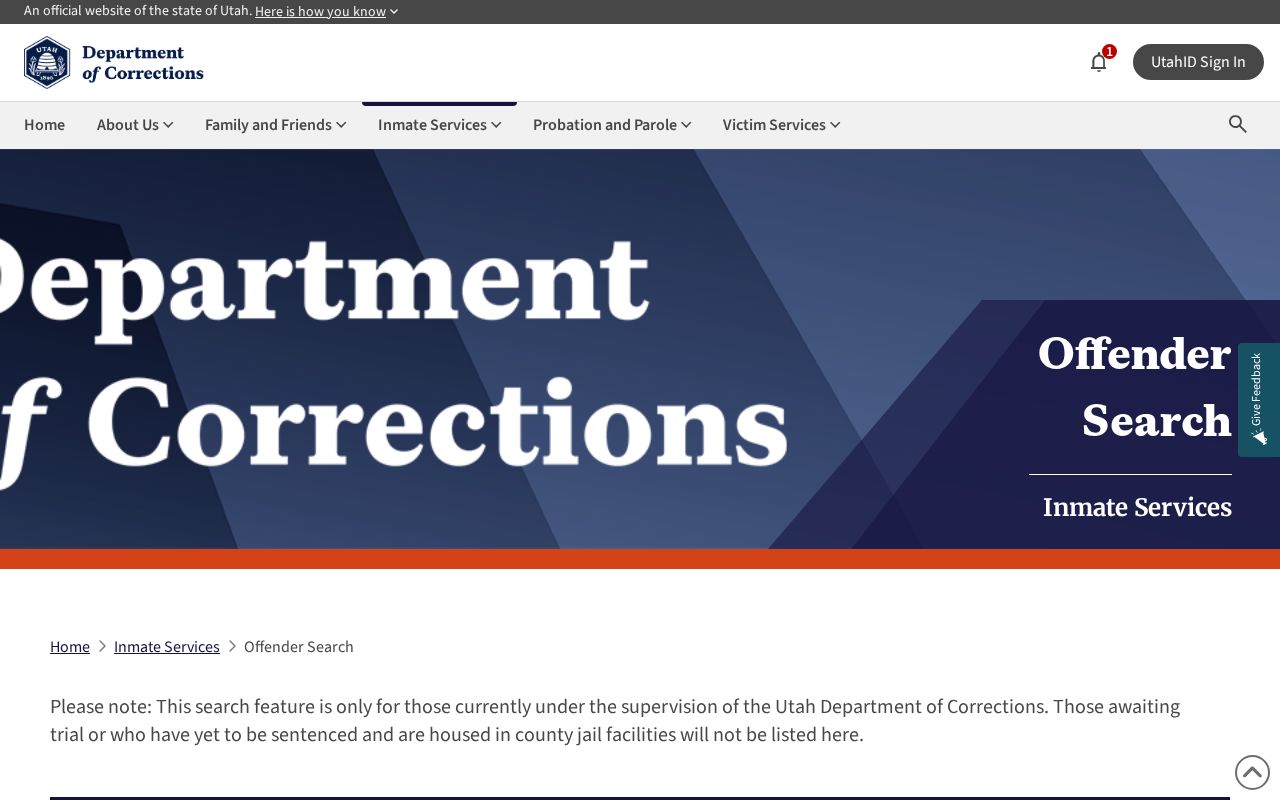
A transition code like Utah State Prison is a hint worth acting on. It points toward a UDC search. It proves nothing about a sentence, though. It cannot tell you where the person sits now or how the case ended.
Utah County Busted Custody Paths
One person can show up in several systems as a case moves along. That is normal. Keep the custody label attached to whatever result you find. Otherwise a released person gets labeled an inmate, or a state prisoner looks newly booked in Utah County. A booking record and a court record belong together in your reading, but they stay separate documents.
| Stage | Best official starting point | What it does not prove |
|---|---|---|
| First 24 hours after booking | Wait for the Sheriff’s stated index availability | That a same-day absence means no booking occurred |
| Current County custody | Current Inmates and booking status | Guilt, final charges, or a court disposition |
| Released or alternate status | Booking detail and published code key | That the person remains physically in the jail |
| UDC custody or supervision | UDC Offender Search | That the record is a new Utah County booking |
| Federal or immigration custody | The relevant federal locator | That the Sheriff roster will show the same result |
A detention result is no substitute for the court file. Check both.
Utah County Court Record Bridge
The Sheriff interface drops court-code clues for Provo, Orem, and Lehi venues. Those codes can narrow a search. They are not a disposition. For filings, hearings, judgments, and completed-case outcomes, Utah Courts Xchange is the home once information reaches CORIS. A booking charge or an A or O jail-status code cannot tell you what a judge decided. Once a matching case is filed, the court’s public case-search page is the outcome path.
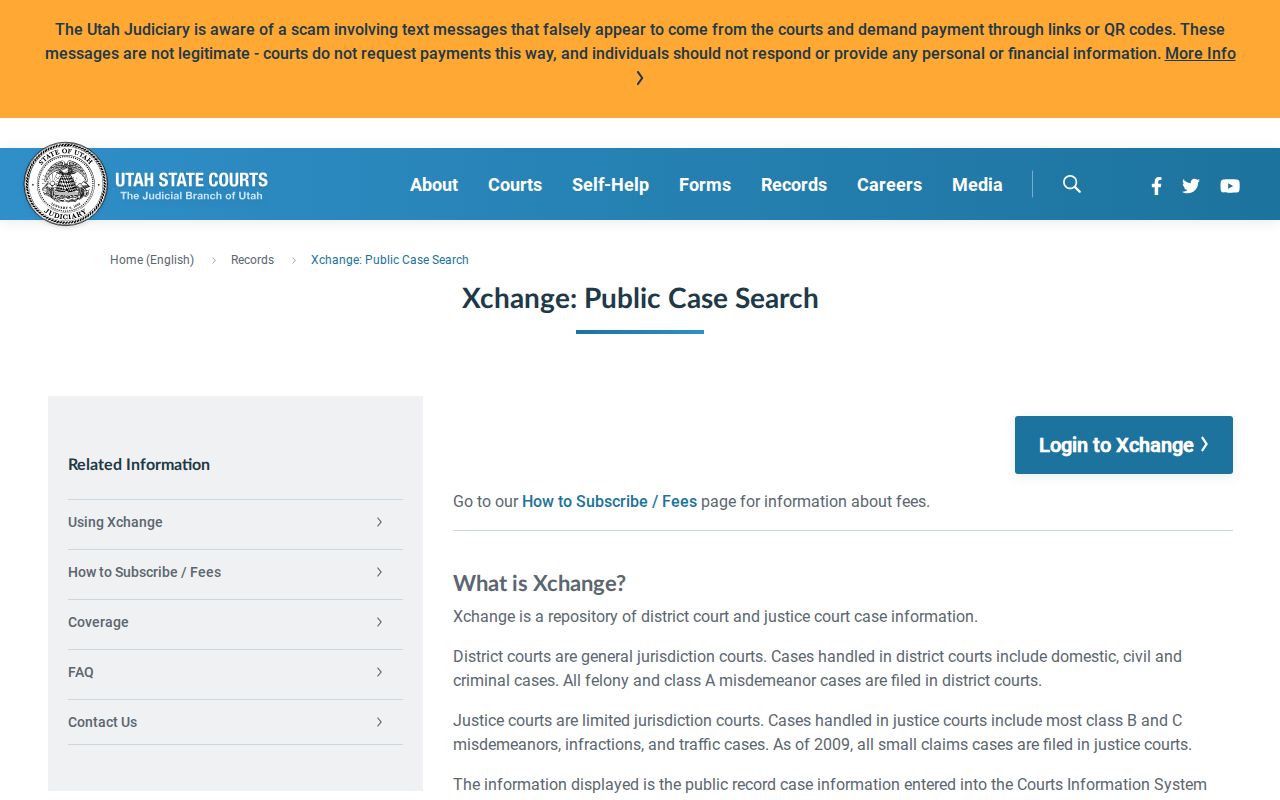
Search the matching name, then filter by Utah County, court, date range, or case number where the system offers it. Venue matters here. District courts handle felonies and Class A misdemeanors, while justice courts take lower-level misdemeanors, infractions, and traffic matters. No Xchange case appearing? Timing, a different jurisdiction, or a legal access limit could explain the gap.
- Booking
- Jail intake and its administrative record.
- Arraignment
- A court proceeding where a charge is addressed.
- Bond
- A release condition, not a finding about the charge.
- Disposition
- The court’s recorded result, such as a judgment or dismissal.
- Expungement
- A legal sealing process with fact-specific rules.
Why Busted Records Disappear
A missing Utah County result or image usually has an ordinary explanation. The Sheriff’s 24-hour posting rule may still be running. The site may have hit its stated display window. A record can also be tied to release, alternative supervision, another facility, a spelling variant, or a different custody system entirely. Juvenile, sealed, expunged, and similar matters carry access limits of their own. A missing booking image is the least surprising gap, since current law shields jail-booking photos unless an exception applies.
Never read age, legal status, or conduct into an absent result. Utah Courts keeps juvenile, sealed, and expunged matters out of Xchange too. A vanishing web record also says nothing about County retention behind the scenes. Public display life and archival treatment are two different things.
Utah County App and Alerts
A phone can go a long way here. The Utah County Sheriff app handles tips, reports, and public-safety alerts, though its store listing says nothing about inmate searches, booking photos, or a jail roster. For arrest and booking questions, the Sheriff's web search stays the dependable route. Social media posts from the Sheriff's Office work the same way. They spread news fast. They just do not amount to a full booking feed or a court docket, so treat them as updates rather than records.
Custody alerts have their own tool. VINE, run through the Utah Department of Corrections, sends notification when someone's custody status changes, and its own guidance says not to lean on it alone for personal safety. So split the jobs. Sheriff search for county bookings, VINE for state custody notices, Xchange when you need to track a court case. Each covers one lane. None of them is a mugshot directory for the whole county.
Note: App alerts and social posts add useful context, but the Sheriff record and the court file still do the real work in their own lanes.
Utah County Busted Secondary Sources
Beyond the official channels, three outside pages work only as secondary cross-references. Any of them can be incomplete or stale. Check dates and status against the Sheriff booking search, then use Xchange for the outcome. RecentlyBooked calls its Utah County section a last-30-days publisher display with recurring updates. Its Utah County page is not a Sheriff feed, though its publisher offers a free first-party correction process for documented circumstances.
Mugshots.com’s Utah County section has city filters for Provo, Orem, and Lehi. Its date controls and records looked old, though. Treat it as a historical curiosity, not a current-custody source. Arrests.org’s Utah date index offers a date-tree path. Yet its local label is unreliable and no city tab checks out, making it a weak cross-reference rather than a city roster. BustedNewspaper and Mugshots.zone had no verified current Utah County page. For events rather than booking lists, Daily Herald, KSL, FOX 13, Lehi Free Press, and the Sheriff Press Archive publish reporting and releases on their own schedules. News photos and publisher displays never replace official booking detail, the protected-image rule, or the court disposition.
Utah County Busted Booking Workload
The Booking Bureau at the County Security Center runs around the clock, yet it pauses some work at set times. Fingerprints, releases, and commitments can't be processed during lockdown windows from 5:15 to 6 a.m. and again from 5:15 to 6 p.m. Commitments are also turned away between 8 p.m. and 6 a.m. These limits describe jail housekeeping, not the website's update schedule. The only timing the site publishes is that it stays available 24 hours a day.
Busy stretches are worth reading with care. A surge in bookings tells you the jail had a heavy day. It says nothing about charges filed, cases opened, or how any one person's matter ends. Look instead at the booking date, the listed status, and the court record that follows.
Utah County City Booking Routes
Provo, Orem, and Lehi each run their own police departments. Still, when a city arrest leads to booking at the County Security Center, the Sheriff's arrested-person index is the documented route for finding that person. No city page qualifies as a daily official arrest log or a booking-photo gallery. Each one does draw a clear line between a municipal records request and the county custody search.
- Provo Busted Mugshots: Provo City Police records route and the Sheriff booking pathway after the posting delay.
- Orem Busted Mugshots: Orem Police records access and the County custody index for a jail booking.
- Lehi Busted Mugshots: Lehi Police GRAMA route and the Sheriff system for a resulting county booking.
Want event-driven county coverage instead of a roster? The site's Crime News & Mugshots section tracks incidents across Utah County. Apply the same caution there and check the source before trusting any single report.
Utah County Older Booking Records
What shows up online is one thing; the county's retention schedule is another. Under the current DARS item GRS-2028, jail prisoner records carry a core retention period of 10 years, then destruction. That rule doesn't promise every digital booking image survives the full term. Older DARS material covered historical mug-shot schedules. None of it guarantees a specific Utah County photo stays viewable for any set length of time.
Hunting an older record? Start with Sheriff Records or Utah County Records Management. Bring the name, an approximate booking date, the arresting agency or facility, and any booking or case number you have. Ask about the current schedule or transfer status for the record you want. Utah State Archives can locate material that has been transferred there. No public Utah County booking-photo collection surfaced anywhere, though. Historic court files remain a separate route and may still fall under expungement limits.