
Utah County Most Wanted List
The Sheriff posts its own picks at the Utah County Sheriff's official Most Wanted list. Click a photo there and more detail appears. That is the whole design. The list is not a jail roster and not a complete warrant roll. An arrest warrant can exist without a person ever showing up here. For anything about one individual, the Sheriff, the court, and defense counsel hold the real answers.
Utah County publishes no entry count for this list. It posts no refresh schedule either. There is no reward, no Crime Stoppers tie-in, and no promise of anonymous reporting. No recurring feature, such as a weekly warrant roundup, appears on the page. An entry can also go stale. Treat the list as an agency notice, not proof that a warrant still stands when you view it.
Utah County Wanted Listing Fields
Each wanted-person detail follows a set format from the Sheriff. It gives identifiers and case-routing facts that help an agency act on a tip. Every field has limits, though. A last known address may be years old. Charges can change, bail is not a case result, and a court case number is only the door into the public court record. Read the fields neutrally rather than as a verdict.
| Field | What the Sheriff detail can show |
|---|---|
| Physical description | Age and descriptors such as height, weight, race, eyes, hair, and scars, marks, or tattoos. |
| Last known address | A past location associated with the listing, not a direction to visit or an assurance of current residence. |
| Charges and bail | The alleged charges and bail information shown by the Sheriff. Neither decides guilt or the final court result. |
| Court case | A case reference that can help route a later search in Utah Courts Xchange. |
| Date added | The date the Sheriff added the person to the Most Wanted list. It is not a stated warrant-issue date or confirmation that the listing was refreshed that day. |
The photos themselves stay on the Sheriff's site. Nothing here reproduces a wanted-person image, and a detail page is not permission to spread a face around social media. If a visual question matters, keep the source and date. Then ask the agency to confirm the person's status.
The fields also show why a listing cannot answer later court questions. A wanted entry captures one moment: a charge type, a bail figure, a case reference. It cannot reveal whether the court accepted a filing, altered a charge, dismissed the matter, or entered judgment. For that stage, pull the case in Xchange. Match the name, date, court, and case number before assuming it is the same event.
Read Utah County Most Wanted Safely
Think of the list as a channel for passing tips to the Sheriff. It is not a substitute for a court search or a warrant check. The steps that follow keep that line clear. They also help you tell the difference between a real warrant record and a booking notation or third-party post that carries no official weight.
- Open the Sheriff’s Most Wanted publication and read the item in its official context.
- Check the visible identifiers and case reference without sharing or recreating the person’s image.
- If there is useful information, send it through the Sheriff’s tip route or call dispatch when time matters.
- For an emergency or immediate threat, call 911. Do not attempt an arrest or personal contact.
- After a reported capture, use the Utah County booking and records route only to learn whether an official county record appears after the Sheriff’s stated timing window.
Two different records cover two different stages. The Sheriff's jail index shows booking status and related jail information. Xchange, the court system, shows filings, hearings, judgments, and outcomes once a case reaches a judge. A person can appear in one and not the other. Check both when the timing of a case matters.
Utah County Tip Contacts
The Sheriff's Tip a Cop form sends submissions straight to the Utah County Sheriff's Office and nowhere else. It asks for a name, email, phone, and address. So anonymity is not on offer. The Sheriff routes time-sensitive incidents to Utah Valley Dispatch and reserves 911 for emergencies. No reward appears anywhere on the form.
The official Tip a Cop form lays out the agency's reporting fields and instructions.
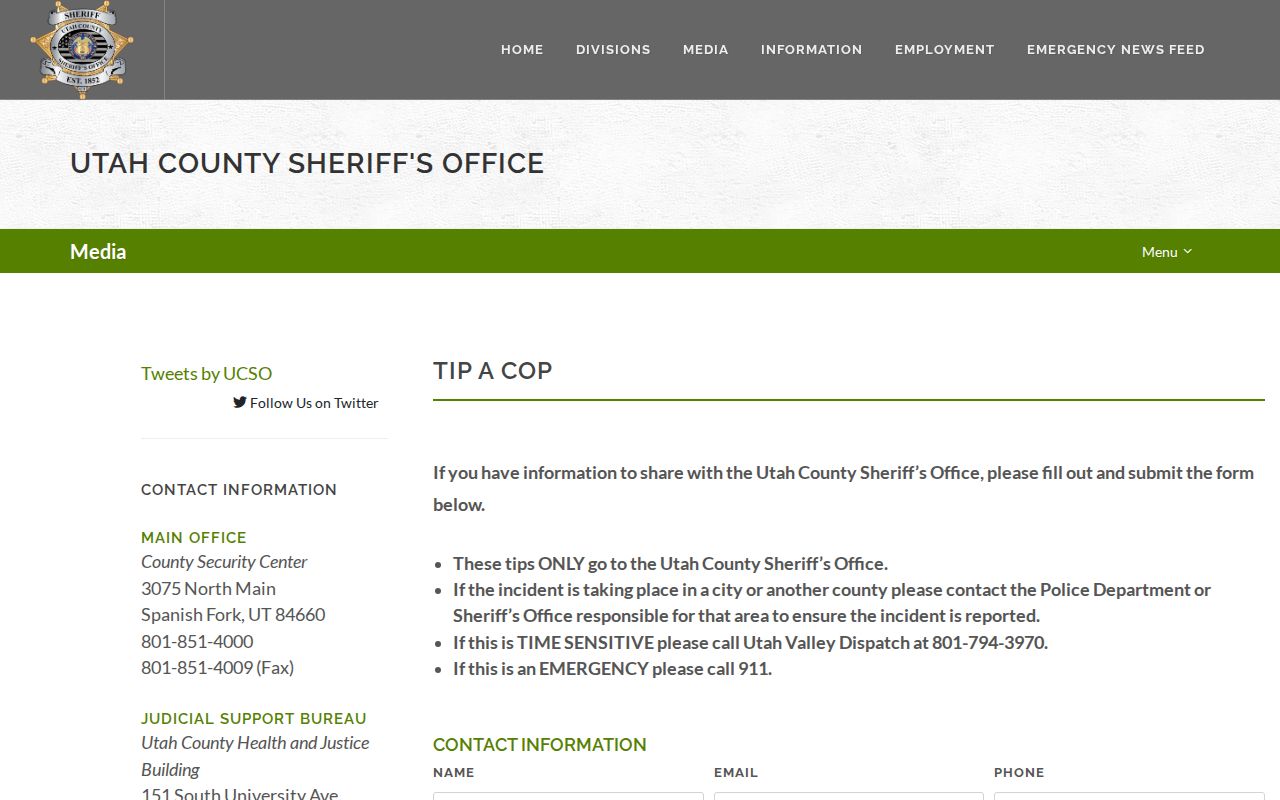
That division of labor makes sense for a wanted-person tip. Routine information goes to the Sheriff. Anything urgent goes to dispatch. True emergencies go to 911.
Tip or urgent report
Non-emergency submission: Sheriff Tip a Cop
Time-sensitive: Utah Valley Dispatch, 801-794-3970
Emergency: 911
Warrant Unit confirmation
Utah County Sheriff’s Office
County Security Center
3075 North Main
Spanish Fork, UT 84660
801-851-4065 or 801-851-4034
Utah County Warrant Check
Spotting a name on a Most Wanted list answers one question. It doesn't settle whether a warrant is active today. For that, the Sheriff's Warrant Unit points people to the Utah State Warrants Search, the state's own lookup tool. Treat the portal as a first step rather than a final word, since it isn't billed as a complete or real-time database, and nothing guarantees photos appear there.
When the portal leaves you unsure, go straight to the source. The Warrant Unit takes calls at 801-851-4065 or 801-851-4034, accepts email at warrants@utahcounty.gov, and can also be reached through the issuing court. If your question involves extradition, that office handles it at 801-851-4040. Anyone who finds a warrant under their own name should talk to a lawyer or the court rather than let it sit. The aim is confirmation and a lawful fix, not dodging the problem.
- Begin with the official state warrant-search route named by the Sheriff.
- Confirm an apparent result with the Sheriff Warrant Unit or issuing court before relying on it.
- Use counsel or the court for an individual resolution question; do not treat an online result or payment page as a clearance.
The Sheriff's booking-search legend includes several warrant-related charge types. Those labels sort booking entries into categories. They say nothing about whether a warrant is still enforceable today.
| Booking key | Sheriff’s category | What it does not establish |
|---|---|---|
| WA | Warrant | That a current warrant remains active. |
| WBW | Bench warrant | That a court has not changed or recalled the order. |
| WIA | Warrant in aid of commitment | That the person is currently in county custody. |
Start with the Sheriff's own tools. The warrant-payment information page asks for identifying details along with court or warrant information. It makes no promise that paying clears anything. Depending on the situation, an item can stay pending until a court appearance happens. So confirm the right route before assuming payment is even an option.
Booking entries carry warrant-related abbreviations too. Labels like WA, WBW, and WIA describe the charge type the Sheriff recorded at booking. They are not proof of an active warrant. They also cannot tell you whether an order has been served or cleared. For that answer, use the state warrant route, the Warrant Unit, or the issuing court.
Custody and warrant status are separate questions entirely. Someone showing as active in the inmate system may have been booked for unrelated reasons. A person with a warrant might not be in the County Security Center at all. Release dates, work diversion, and transfers settle nothing about a warrant. The wanted list asks for tips, the warrant search checks an order, the booking index describes jail processing, and Xchange covers public court history. Each tool has its own job.
Utah County Wanted Record Limits
An arrest made on a tip does not show up right away. Utah County waits 24 hours after booking. Then the information becomes public. The Sheriff's Arrested Person Search can be checked by name or arrest date. It answers a different question than the Current Inmates option. The name search covers past or present county processing, while the current list shows only people in custody now.
A match still does not mean someone sits in a cell today. Check the status key first. It separates active custody from released, electronic monitoring, work diversion, medical refusal, placement in another facility, and other conditions. Detail fields list the arrest date, booking date, booking number, release date when one applies, arresting agency, and current status. Read the status before claiming anyone remains locked up.
State custody runs through a separate channel. When a person enters Utah Department of Corrections custody or supervision, the UDC Offender Search is the official state locator. It works by name or UDC number. It cannot replace a fresh Utah County booking lookup, though. Keeping the Sheriff's list, the county booking index, the state locator, and the warrant system straight prevents a wrong label from turning into a safety or legal claim.
Utah County Alerts Have Limits
The Sheriff's app has real value, but it isn't a records desk. Its iOS listing and Android listing describe a channel for tips, reports, interactive features, and public-safety updates. Neither listing promises an inmate search, a booking-photo lookup, or a running roster feed. So use the Sheriff's web search for county booking details, and save the app for the agency communication it actually delivers.
UDC VINE plays a different part entirely. It sends custody notifications tied to the Utah Department of Corrections and flatly warns users not to lean on it alone for safety. It is not a Utah County booking feed, and it can't substitute for confirming a warrant. Each channel here answers a different question, whether that's the Sheriff's page, the Warrant Unit, dispatch, or the court.
Social media rounds out the picture, with limits of its own. The Sheriff homepage links out to official Facebook, Instagram, YouTube, and X accounts, and those channels do carry general public-safety updates. What they don't offer is any verified schedule of booking posts or a steady mugshot feed. A social post is just that: one post. Read it as a single update, never as a full roster or a court outcome.